> For the complete documentation index, see [llms.txt](https://docs.linuxfoundation.org/lfx/llms.txt). Markdown versions of documentation pages are available by appending `.md` to page URLs; this page is available as [Markdown](https://docs.linuxfoundation.org/lfx/project-control-center/v2-latest-version/collaborations/meetings/scheduling-a-meeting.md).
# Scheduling a Meeting
You can use this feature to schedule a future meeting or a past meeting to record attendance in the PCC meeting management tool.
1. Log in to [PCC.](https://projectadmin.lfx.linuxfoundation.org/project/a0941000002wBz4AAE/collaboration/meetings)
2. Search for the required project.
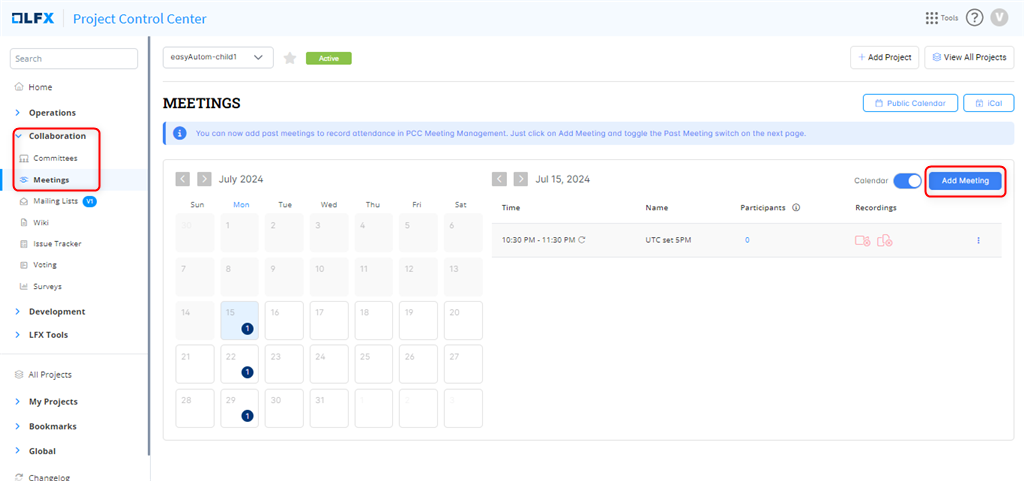
3. Navigate to the **Collaboration > Meetings** tab on the left sidebar.
4. On the **Meetings** page, click **Add Meeting**.
5. On the next page, you can either schedule a future meeting or click the **Past Meeting** toggle button to add a past meeting.
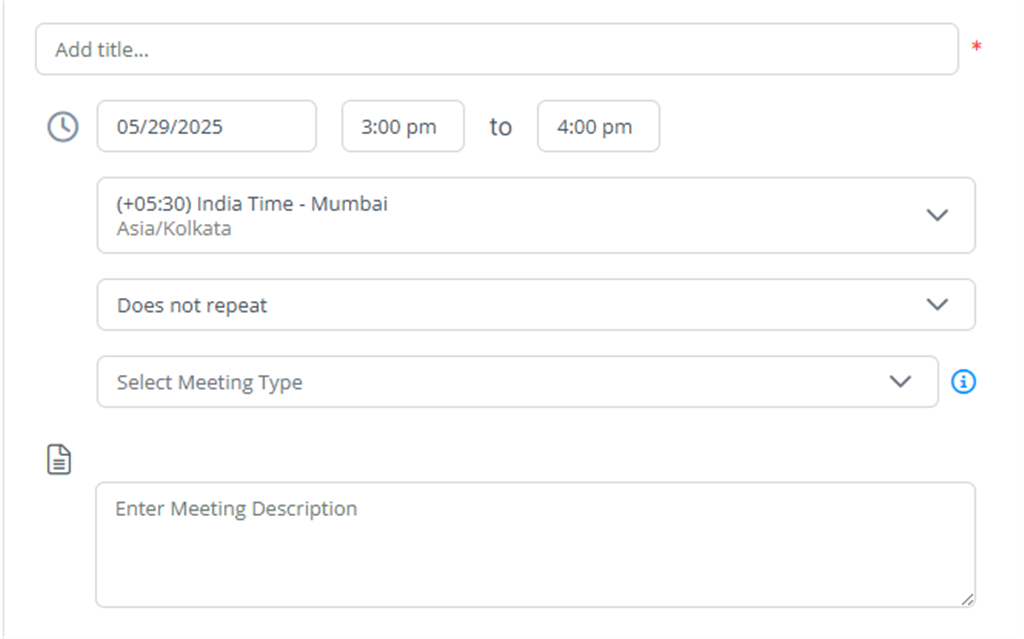
6. Update the following details on the Schedule Meeting page:
{% hint style="info" %}
**Remember:**
1. Enter a descriptive title for your meeting.
2. Select the meetings time and time zone.
3. Select the meeting recurrence if your meeting repeats.
4. You must select the correct [meeting type](#meeting-types) to track attendance accurately, as it ensures correct reporting in the health metrics. Select `Board` only for official board meetings.
5. Provide a detailed meeting description so the meeting attendees have a clear agenda for the meeting.
{% endhint %}
Meeting Types
* **None**\
Select if your meeting doesn’t fit into any specific open source category.
* **Legal**\
Choose this for discussions about open source licensing, contributor agreements, policies, or any legal matters affecting your project or foundation.
* **Board**\
For meetings involving the foundation’s board members or leadership, such as governance discussions, strategic planning, or key decision-making.
* **Maintainer**\
For maintainers coordinating the direction of an open source project. Use for meetings about code review, managing pull requests, release planning, or handling community contributions.
* **Marketing**\
Select meetings focused on promoting open source projects or community initiatives, such as outreach, branding, communication strategies, or community engagement.
* **Technical**\
Use it for in-depth technical discussions, such as architecture reviews, infrastructure planning, development sprints, issue triage, or technical problem-solving in your project.
* **Others**\
For community meetings or activities that support the open source foundation or projects, but don’t fit the above categories.
#### Add meeting participants
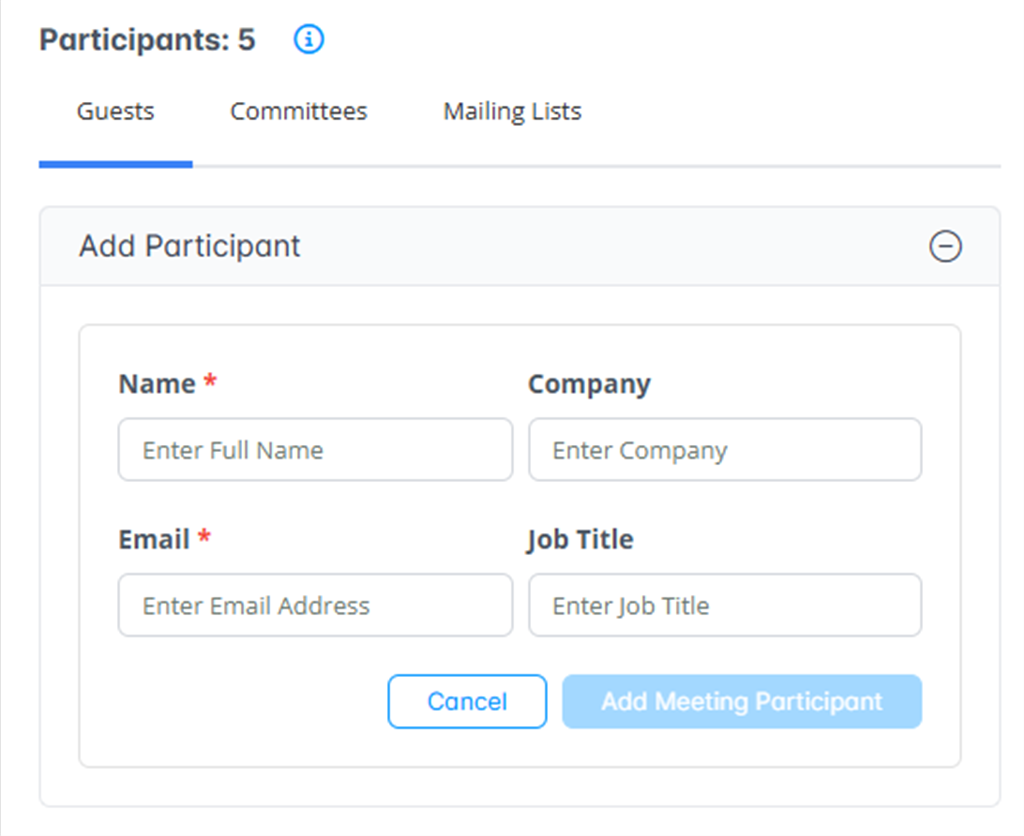
7. You have the following three options to add participants to your meeting:
1. **Guests:** Add the name, email address, and other details of the participant, then click **Add Meeting Participant** button.
2. **Committees:** Click **the Committees tab** and select the required committees from the drop-down that you want to invite for the meeting. You can invite more than one committee.
3. **Mailing Lists:** When choosing a mailing list, members are imported a single time as individual participants. Continuous synchronization is not available as members are added, updated, or removed from the list. You can choose more than one mailing list to add to the meeting.
4. **Meeting Participant Import:** The platform now supports bulk importing participant lists that allows for more than the current 200 participant limit, significantly reducing administrative overhead for large meetings and events. Use the **Import CSV** button
Adding Participants
{% hint style="info" %}
* You can also add yourself to the meeting by clicking **+ Add yourself to the meeting**. You can remove the participant by clicking the delete  icon.
* When scheduling a **non-recurring meeting**, select **Does Not Repeat** while updating the meeting frequency.
* A recurring meeting is indicated with icon.
{% endhint %}
#### Additional Settings
8. Before scheduling the meeting, **Toggle ON** these additional meeting settings:
1. **Show in Public Calendar**: Toggle ON to list this meeting on your organization’s public calendar so everyone can see it.
2. **Restrict to invited users**: Allow only the users you invite to join the meeting, ensuring privacy and limiting attendance to selected participants. Only invited users can join the meeting. If the meeting is listed on the Public Calendar, users must contact someone with PCC access to be added.
3. **Let users join early**: Allow participants to enter the meeting room before the scheduled start time, which can help them test their connection or get settled. Default joining time is 10 minutes early; you can set a custom time above 10 minutes but not shorter than 10 minutes. This is saved with the meeting and will be used again if you edit the meeting later.
4. **Send reminder email to participants**: Automatically send a reminder email to all participants before the meeting starts. You can set the reminder time between 2 and 24 hours before the meeting. When set to 24 hours, minutes are automatically set to 0.
5. **Record this meeting**: Automatically record the meeting so you or others can review it later or share it with those who couldn’t attend. Automatically record the meeting when it starts. The video link will appear in PCC, the Individual Dashboard, and/or the Public Calendar based on your visibility settings below.
1. When you enable this option, you can :
1. Create the transcript from the Zoom recordings. It will have the same visibility settings as the recordings (refer to point g).
2. Upload the meeting recordings to YouTube. When YouTube upload is enabled, keep your meeting title to 87 characters or fewer — YouTube titles are limited to 100 characters, and the upload process automatically appends a date suffix to the meeting title.
6. **Enable Zoom AI Summary:** Use Zoom’s AI features, such as live transcriptions or summaries, to enhance the meeting experience and capture important points.
1. **Review the AI summary before publishing:** Check and edit the AI-generated summary before sharing it with participants to ensure accuracy and relevance.
2. **Who can review and edit the AI summary?** 1. Anyone who claimed host in that specific meeting. 2. Anyone who has a role to manage project meetings (e.g., Project Admin, Meetings Coordinator).
3. **How to review and edit the summary?** Zoom will send an email when the summary is ready for review. Follow the link in the email. You must log into your LF account that was host/admin for the meeting. If you share the link with a person who was not host/admin, they will be able to view the summary, but not edit or publish.
7. **Where should users see the link(s) to the AI summary?** Choose where participants can access the AI meeting summary—either only in the PCC tool or both in PCC and their Individual dashboard.
#### How Zoom AI Summaries Work
When Zoom AI is enabled for a meeting, it generates an automated summary after the meeting ends. According to Zoom, summaries typically become available within a few minutes to an hour after a meeting ends, though they can occasionally take up to three hours. Longer meetings generally take more time to process.
**Important: Enable AI Before the Meeting Starts**
Zoom AI must be enabled before the meeting begins. If AI is toggled on after participants have already joined, Zoom will not move the meeting to an AI-enabled host — the meeting continues on the original host user, which may not have AI enabled. In this case, no summary will be generated. To verify AI is active during a meeting, look for the AI options in the Zoom toolbar. If they're visible, AI is running successfully.
**If You Enabled AI After the Meeting Started** If you realize AI wasn't enabled at the start, you can attempt the following recovery steps:
1. Claim host in the meeting.
2. End the meeting for all participants ("End Meeting for All").
3. Rejoin the meeting — Zoom will attempt to move it to an AI-enabled host.
Note: This will briefly interrupt the meeting for all participants.
If the meeting has already ended without AI active, the summary cannot be retrieved retroactively.
#### Host Keys
{% hint style="info" %}
* In the Edit Meetings page, the participants list will have a column for "Share Host Key". Use the check box in the user's column to allow them to view the host key. Participants with whom you've shared the host key will gain access to it in their Individual Dashboard 1 hour before the meeting commences.
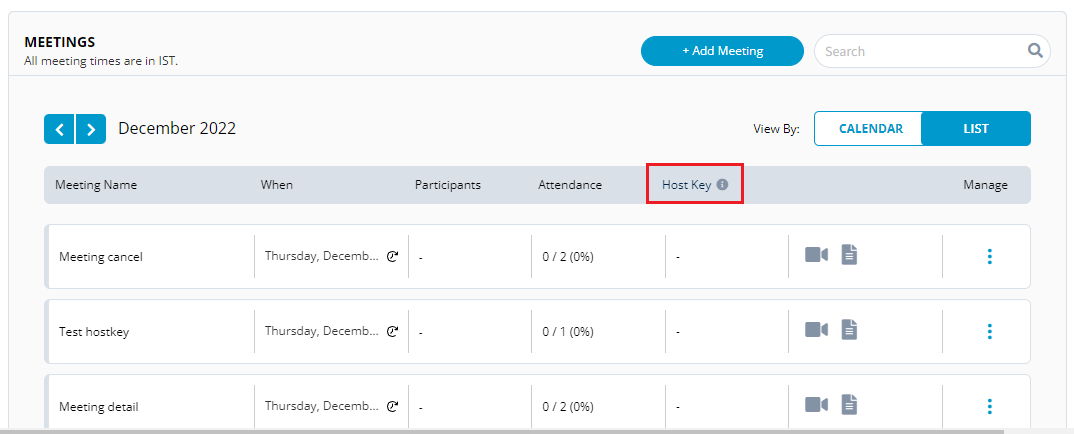
* In the Meeting list, the Host Key field will be blank until the meeting is less than one hour from its scheduled start time.
* Once the meeting is less than one hour away, the Host Key will appear in the Host Key row for that meeting, and in the Individual Dashboard of anyone checked as host.
* You can then view or copy the Host Key to enter it in Zoom and claim the host for your meeting.
* Note: The Host Key is valid only for the upcoming meeting.
{% endhint %}
Host Key
{% hint style="info" %}
The Host Key appears as a masked key when the meeting is within one hour of the scheduled time. You can click the icon to see the host copy and click the icon to copy the host key.
{% endhint %}

---
# Agent Instructions
This documentation is published with GitBook. GitBook is the documentation platform designed so that both humans and AI agents can read, navigate, and reason over technical content effectively. Learn more at gitbook.com.
## Querying This Documentation
If you need additional information that is not directly available in this page, you can query the documentation by asking a question.
Perform an HTTP GET request on the following URL with the `ask` and `goal` query parameters:
```
GET https://docs.linuxfoundation.org/lfx/project-control-center/v2-latest-version/collaborations/meetings/scheduling-a-meeting.md?ask=&goal=
```
`ask` is the immediate question: it should be specific, self-contained, and written in natural language.
`goal` is what the user is ultimately trying to achieve, the reason they need the answer. Sharing it helps GitBook give you a better, more relevant answer. A goal is most helpful when it describes the outcome the user wants rather than restating the question. For example, with `ask=how do I create an API token`, a goal like `automate deployments from our CI pipeline` lets GitBook tailor the answer to that use case.
The response will contain a direct answer to the question and relevant excerpts and sources from the documentation.
Use this mechanism when the answer is not explicitly present in the current page, you need clarification or additional context, or you want to retrieve related documentation sections.
 icon to see the host copy and click the
  icon to copy the host key.
{% endhint %}

---
# Agent Instructions
This documentation is published with GitBook. GitBook is the documentation platform designed so that both humans and AI agents can read, navigate, and reason over technical content effectively. Learn more at gitbook.com.
## Querying This Documentation
If you need additional information that is not directly available in this page, you can query the documentation by asking a question.
Perform an HTTP GET request on the following URL with the `ask` and `goal` query parameters:
```
GET https://docs.linuxfoundation.org/lfx/project-control-center/v2-latest-version/collaborations/meetings/scheduling-a-meeting.md?ask=
icon to copy the host key.
{% endhint %}

---
# Agent Instructions
This documentation is published with GitBook. GitBook is the documentation platform designed so that both humans and AI agents can read, navigate, and reason over technical content effectively. Learn more at gitbook.com.
## Querying This Documentation
If you need additional information that is not directly available in this page, you can query the documentation by asking a question.
Perform an HTTP GET request on the following URL with the `ask` and `goal` query parameters:
```
GET https://docs.linuxfoundation.org/lfx/project-control-center/v2-latest-version/collaborations/meetings/scheduling-a-meeting.md?ask=